The Operational Question
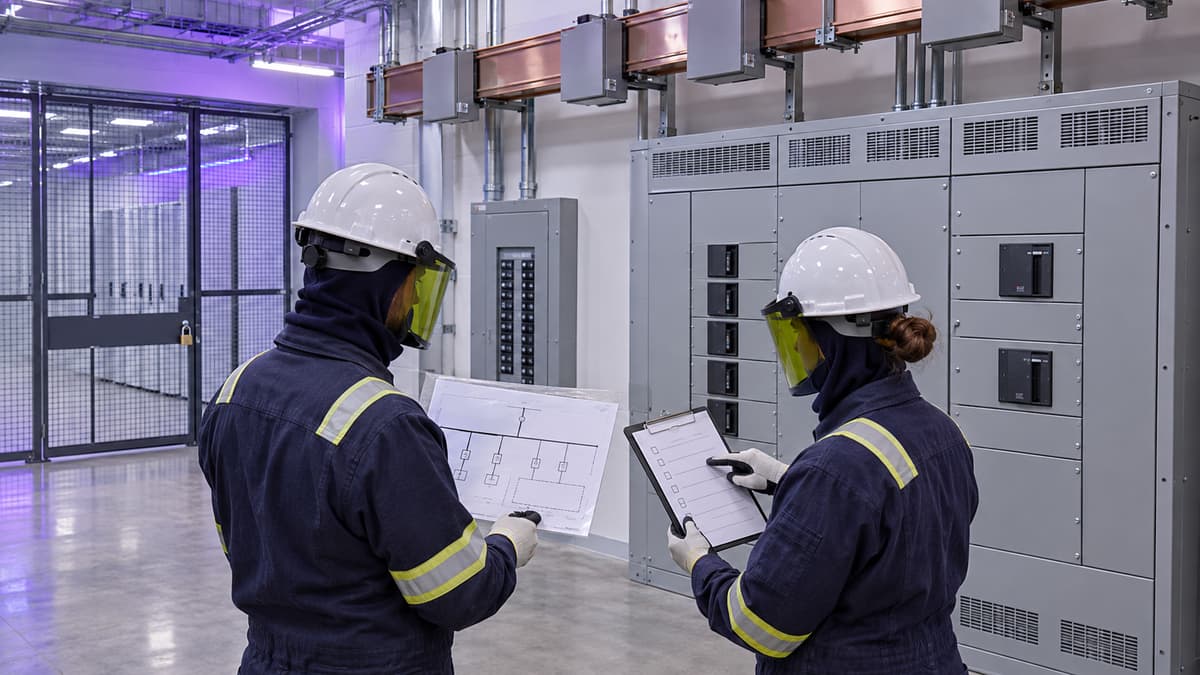
Energizing a new customer suite in a colocation facility is not just a matter of closing the next breaker. The facilities team must confirm that the approved load, distribution path, protective devices, labels, work boundaries, and communications plan all describe the same physical installation before power is applied.
That question becomes more important when a customer is waiting on a promised turn-up date, a contractor has completed a late change, or a new suite shares upstream equipment with occupied space. A mistake can create an unexpected trip, an unsafe exposure, a disputed handoff, or a service interruption that reaches customers who were never part of the work.
This guide gives facility managers, electrical supervisors, critical facilities technicians, and colocation project leads a practical readiness framework. It focuses on what to verify before energizing a customer suite, how to separate documentation checks from field checks, and how to build a role-based training plan around the work. It is a planning and best-practice guide, not a substitute for the site's electrical safety program, qualified-person requirements, engineering review, or written switching procedure.
Who This Affects
The immediate audience is the team responsible for a new or expanded customer space, but the work crosses several roles:
- Facility managers who authorize the readiness review and accept the operational risk.
- Electrical supervisors and qualified electricians who review the one-line, protection, isolation points, and switching sequence.
- Critical facilities technicians who inspect panels, busway tap boxes, PDUs, grounding and bonding, and local indications.
- Commissioning agents and project leads who track punch-list closure, test records, and turnover documents.
- Customer operations contacts who need to know when the suite is ready, what load was approved, and which alarms or access rules apply.
- EHS, security, and compliance staff who may review permits, work boundaries, access controls, and incident reporting.
The same readiness question appears in several site types. An enterprise campus may be energizing a new room for an internal business unit. A colocation site may be turning up a customer cage, private suite, or row of cabinets. A hyperscale facility may be handing a completed electrical block to operations. An edge site may have fewer people, less redundancy, and less room for an error to be absorbed.
The work is also common during brownfield changes. A customer may add cabinets to an existing suite, replace a PDU, change a panel schedule, or request a higher density than the original design assumed. In each case, the team should treat the change as a controlled operational event, even if the physical scope looks small.
What Can Go Wrong
The most visible failure is an unexpected trip when the new load is connected. The initiating problem might be a mislabeled breaker, an incorrect phase assignment, a protection setting that does not match the approved design, an unresolved short-circuit study action, or a customer load that is materially different from the request. The trip may affect only the new suite, or it may expose a weak point upstream.
Safety risk is just as important. A drawing can be correct while the field installation is incomplete, and a panel can appear quiet while another source remains available through a tie, bypass, generator, UPS, or alternate feeder. Workers may also be exposed when a temporary barrier is removed too early, a panel cover is missing, a cabinet is not secured, or a contractor assumes that a customer-side disconnect is the only isolation point.
Compliance and governance problems often start with ordinary paperwork. If the permit, switching order, equipment label, and customer work order use different identifiers, the team may have difficulty proving what was authorized. That weakens the site's incident investigation, maintenance history, and audit trail even when the turn-up appears to succeed.
Cost can show up later. A poor handoff creates repeat visits, emergency troubleshooting, disputed responsibility for alarms, and maintenance records that do not match the equipment. A customer may believe its suite is fully redundant when only one path was tested. A facility may also carry an avoidable operational burden if every future service call requires rediscovering the original power path.
Electrical safety programs commonly require a documented approach to de-energized work, verification of an electrically safe work condition when applicable, qualified persons for specific tasks, and controls for energized work when it cannot be avoided. NFPA 70E is a widely used consensus reference for electrical safe work practices, but the site's employer program and adopted requirements govern the work. The goal of this review is to make the planned energization understandable and controlled, not to turn a blog checklist into a switching authorization.
No checklist can make an unapproved switching sequence safe. If the field condition, drawing, or responsibility is unclear, pause the turn-up and escalate through the site's procedure.
What Managers Should Check
Use the review as a gate with named owners. A manager should be able to answer who checked each item, what evidence was reviewed, and what condition would stop the work.
- Confirm the approved scope and customer load
Start with the service request, design package, and current customer agreement. Identify the suite, cabinets or equipment served, requested voltage and phase arrangement, initial load, expected growth, and any special startup behavior. A nameplate rating is not the same as operating load, and a peak demand estimate is not the same as the capacity reserved upstream.
Ask the project lead to identify changes made after the original approval. A revised PDU location, a different breaker frame, a changed busway tap, or a new customer power distribution unit may require engineering review and updated records. Do not let a field change hide inside a closeout email.
- Walk the electrical path from source to customer disconnect
Trace the path in the field and on the current one-line. Depending on the design, it may include service or generator-backed switchgear, an automatic transfer switch, UPS output, switchboard or panelboard, busway, tap box, remote power panel, PDU, and the customer disconnect. Verify that each identifier is visible and matches the approved record.
Look for physical conditions that a drawing review will not catch:
- Missing deadfronts, covers, barriers, blank fillers, or enclosure hardware.
- Unsecured or damaged busway tap boxes and cable entries.
- Unlabeled spare breakers that could be mistaken for the customer feeder.
- Obstructed working space, stored material, temporary cords, or trip hazards.
- Grounding and bonding connections that are incomplete or not documented.
- Temporary construction power or test equipment still connected to the path.
- Reconcile protection and coordination information
The responsible electrical engineer or qualified reviewer should confirm that the protective-device identification and settings match the approved design. The review may include breaker rating, trip unit settings, upstream coordination, available fault-current information, and the status of required study updates. Managers do not need to perform the engineering calculation themselves, but they do need a clear record showing that the right review occurred.
If the facility uses selective coordination goals for critical paths, ask how the new feeder fits with the existing scheme. If an electronic trip unit was replaced, a setting may have returned to a default. If a breaker was moved between sections, the label may be correct while the underlying protection record is stale.
- Verify isolation, switching, and test boundaries
The switching authority should identify the normal source, alternate source, bypasses, ties, backfeed possibilities, and any point where customer equipment can remain energized. The written sequence should identify the people communicating, the expected indications, the stop points, and the restoration order.
Check that the work area is controlled for the actual task. The boundary, approach limits, PPE, test instruments, and energized-work decision should come from the site's electrical safety program and the job-specific risk assessment. If the planned task is de-energized, the team must follow the site's lockout/tagout and verification process. If the task requires energized testing, only the people and controls authorized by the program should participate.
- Confirm testing and evidence
Review the test package before the final turn-up meeting. The exact tests depend on the equipment and site procedure, but the package may include torque records, insulation or continuity checks, phase identification, protective-device verification, control wiring checks, alarm checks, infrared or visual inspection records, and functional test results.
Make the evidence easy to connect to the asset. Each record should identify the equipment, date, person or company performing the work, instrument information when relevant, acceptance criteria, result, and exception status. A folder of photographs without asset identifiers is not a durable turnover package.
- Verify customer-side readiness
The suite should not be declared ready simply because the facility feeder is available. Confirm that the customer has completed its own pre-energization checks, that the intended equipment is installed or safely isolated, and that the customer understands the approved load and power path. Agree on who will observe the first energization and who can stop the work.
If the customer has dual-corded equipment, document which cord lands on which source and what the site has actually tested. If the customer is bringing a temporary load bank, test cart, or commissioning device, document its rating and removal plan. If a customer has not supplied final load information, keep the status conditional rather than treating a verbal estimate as the design basis.
- Plan the communications and recovery path
Before the event, publish the start window, participants, contact methods, expected indications, and escalation path. Include the NOC or operations desk when alarms, monitoring points, or customer notifications are involved. Identify the nearest upstream equipment that could be affected and the decision maker for a pause or rollback.
The recovery plan should be specific. It should state what the team will do if a breaker trips, a phase indication is wrong, a monitor does not update, a customer device fails to start, or an alarm remains active. The point is not to predict every fault. It is to prevent the first unexpected indication from becoming a debate about who has authority.
- Close the handoff after successful energization
Record the final state, not just the fact that power was applied. Capture actual breaker positions, alarms, meter readings, monitoring points, customer confirmation, outstanding limitations, and the date for the next inspection or load review. Update the one-line, panel schedule, asset record, customer work order, and maintenance ownership.
Use a short post-turn-up review to ask what differed from the plan. A successful energization can still reveal a confusing label, an alarm with the wrong priority, or a communication gap that should be fixed before the next suite is turned up.
Which Training Fits This Situation
This work crosses power knowledge, safe work practice, and operations discipline. A single course may help one role, while a small role-based plan gives the team a shared vocabulary.
For electricians and electrical supervisors, Power Distribution Systems Fundamentals and Power Systems & Electrical Fundamentals provide useful grounding in the distribution path, equipment relationships, and facility-scale power concepts. Data Center Electrical Safety Training supports the safe-work side of the review, including the need to follow the employer's program and qualified-person boundaries. A team that owns UPS-backed paths may also add UPS Systems Fundamentals or UPS Operations & Load Testing when the turn-up passes through those systems.
For facility managers and project leads, Data Center Operations Management helps connect the technical review to work control, handoff, documentation, and uptime responsibilities. Infrastructure Commissioning & Startup is relevant when the customer suite is part of a new build, expansion, or formal commissioning sequence. Incident Response & Troubleshooting can help operations staff rehearse what to do when the first energization produces an unexpected alarm or trip.
The Power & Electrical Systems Bundle is the most direct bundle for a team that needs broader coverage across power architecture, UPS, generators, batteries, electrical safety, arc flash, EPO procedures, and distribution fundamentals. It does not replace site qualification or task-specific authorization. It can support a common knowledge baseline before managers assign supervised field practice.
A practical role-based plan might look like this:
- Customer-suite project lead: Infrastructure Commissioning & Startup plus Data Center Operations Management.
- Electrical supervisor: Power Distribution Systems Fundamentals plus Data Center Electrical Safety Training.
- Critical facilities technician: Power Systems & Electrical Fundamentals, then supervised site procedures for the actual equipment.
- NOC or operations desk staff: Incident Response & Troubleshooting plus a facility-specific alarm and escalation walkthrough.
- Customer-facing coordinator: a shorter orientation on approved load, source naming, access rules, and handoff evidence.
These are self-paced knowledge and best-practice courses. Learners receive a certificate of completion, but the courses do not grant a license, regulatory certification, CEUs, or PDHs, and they do not imply approval or endorsement by OSHA, NFPA, an equipment manufacturer, or another standards body.
Common Mistakes to Avoid
- Treating a customer work order as the electrical design record. The work order should point to the approved drawings and current asset information.
- Checking only the new panel. Trace the full upstream and downstream path, including alternate sources, ties, bypasses, and monitoring points.
- Assuming a breaker label proves the circuit identity. Reconcile field identifiers with the one-line and the site's verification process.
- Letting schedule pressure turn a conditional approval into a final authorization. An unresolved item needs an owner and a stop condition.
- Using a generic switching template without adapting it to the actual source, equipment, people, and recovery plan.
- Asking a contractor to explain a protection or safety decision that belongs to the site's responsible engineer or electrical authority.
- Forgetting the customer-side load behavior. Startup inrush, power supplies, transfer behavior, and temporary test equipment can change the event.
- Closing the ticket when the breaker closes. The handoff is incomplete until records, alarms, monitoring, ownership, and customer confirmation are updated.
- Treating online training as a substitute for hands-on qualification. Training can build knowledge, while site procedures, supervised practice, and employer authorization establish what a person may do.
Key Takeaway
Customer-suite power turn-up is a controlled electrical and operational handoff, not a single switching action. The best readiness review connects the approved load to the actual distribution path, verifies protection and safe-work boundaries, confirms customer and operations readiness, and leaves behind records that the next shift can use.
This week, choose one upcoming customer turn-up and run a 30-minute field walk with the project lead, electrical supervisor, and operations desk. Trace the path from source to customer disconnect, compare three identifiers to the current one-line, and write down the one condition that would make the team stop before energization.
Sources
- Occupational Safety and Health Administration: Electrical - Overview
- National Fire Protection Association: NFPA 70E Standard for Electrical Safety in the Workplace
- U.S. Department of Labor: Control of Hazardous Energy (Lockout/Tagout), 29 CFR 1910.147
- U.S. Department of Labor: Electrical Safety-Related Work Practices, 29 CFR 1910.333