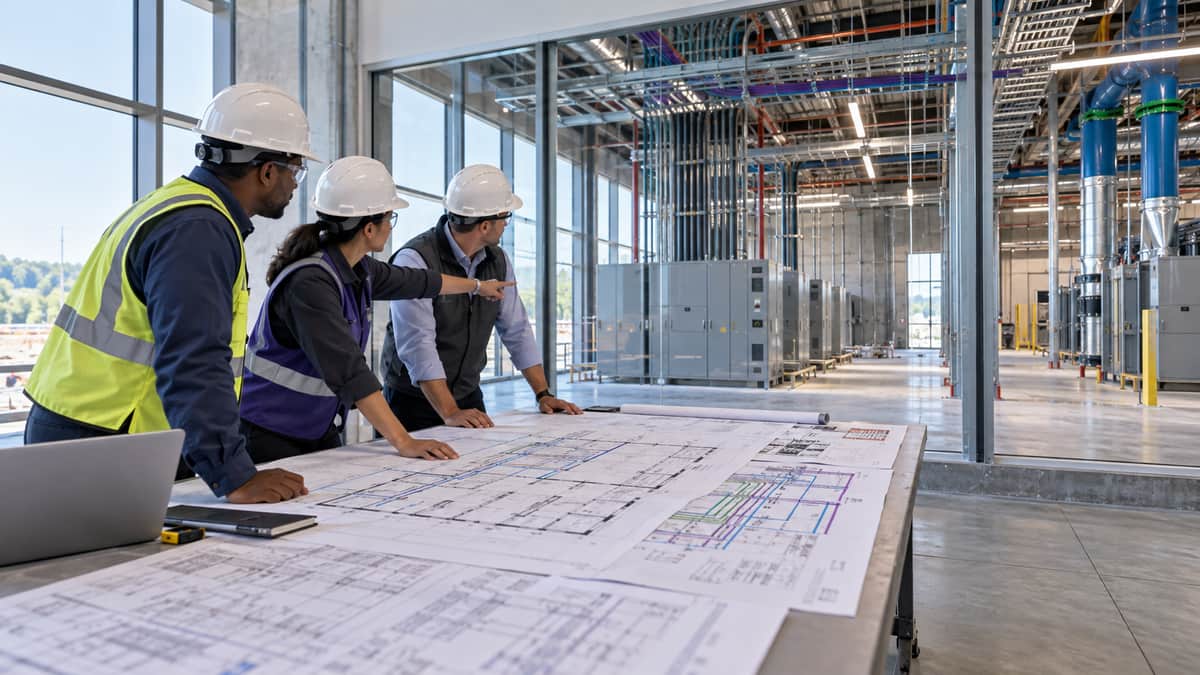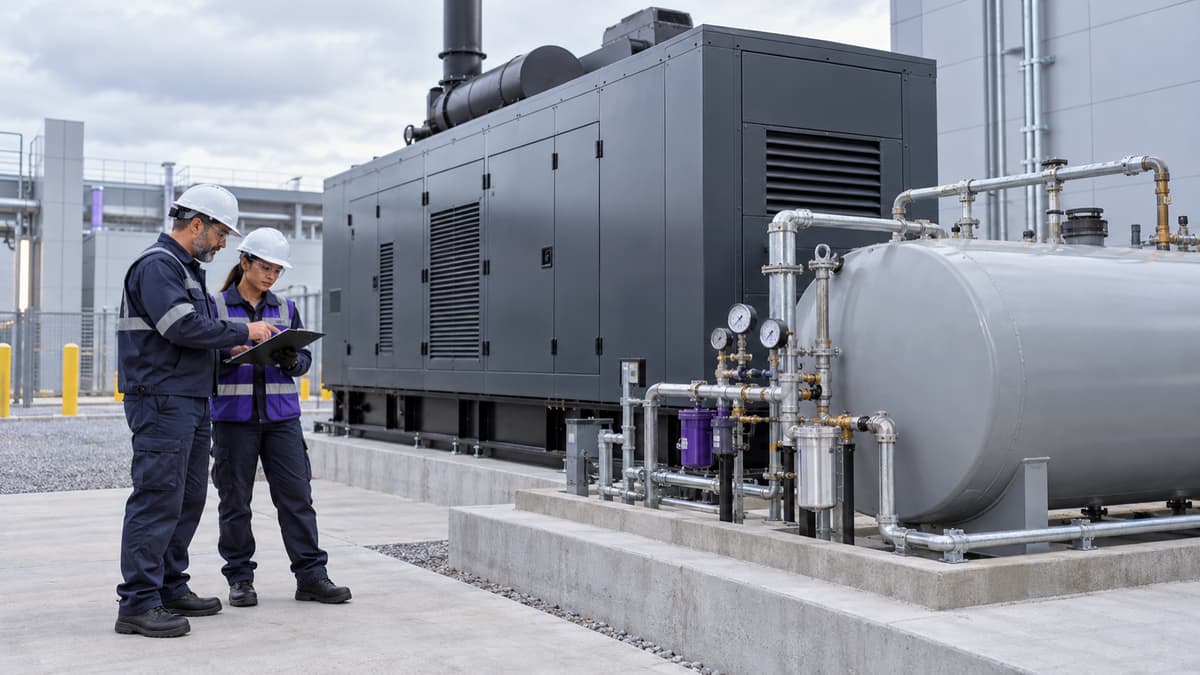
The Operational Question
Before a data center team starts a generator load test, is the fuel system ready to support the test without creating a leak, a nuisance shutdown, or a false sense of standby-power readiness? The generator enclosure may look serviceable while a day tank, transfer pump, vent, filter, valve, or fuel record is not ready for the planned run. This guide gives facility managers, generator technicians, and operations leads a practical way to review fuel-system readiness before a test is scheduled, and it explains how the review connects to role-based training.
The goal is not to teach a technician to improvise repairs or operate outside the site procedure. It is to make the pre-test conversation specific. After reading, a team should be able to identify the fuel components that matter, confirm who is authorized to inspect or test them, recognize conditions that require a stop, and document what was checked before the generator is asked to carry load.
Who This Affects
This readiness review is useful wherever standby generators support critical loads, including:
- Enterprise data centers with a dedicated generator yard and automatic transfer switches.
- Colocation facilities where a maintenance window must be coordinated with several customers and operating teams.
- Hyperscale campuses with multiple generator groups, bulk storage, day tanks, fuel polishing systems, and sequenced starting controls.
- Edge sites and smaller facilities where one generator, one tank, or one transfer pump may be a single point of failure.
- Contractors performing generator maintenance, controls work, fuel delivery, or load-bank testing.
- New facility technicians who understand electrical equipment but have not yet learned the site’s fuel system and emergency response boundaries.
The review normally involves a facilities manager, generator or mechanical technician, electrical operator, control-room or NOC representative, and the person coordinating the maintenance window. EHS staff may also need to participate when the work involves fuel exposure, spill response, hot work restrictions, traffic controls, or environmental records.
The same review looks different by site type. An enterprise site may focus on a single generator’s day tank and a clear test sequence. A colocation site may need customer communications, bypass planning, and evidence that the test will not interfere with another maintenance activity. A hyperscale or campus environment may need to confirm the order in which generators start, how fuel transfer is prioritized, and whether a common bulk tank or control panel can affect several generator groups at once.
What Can Go Wrong
A load test can expose weaknesses that a visual walk-through misses. The consequences range from a canceled test to an actual loss of backup capacity.
Fuel quality can be a problem even when the tank gauge shows an adequate level. Water, sediment, microbial growth, or aged fuel can restrict filters and reduce engine performance. A generator may start and then lose power as the filter loads under demand. A clean-looking sample from one point does not prove that the entire storage and transfer path is clean.
A transfer problem can create a different failure. A day tank may have fuel, but the pump, float switch, solenoid, control circuit, or low-level alarm may not operate as expected. A stuck valve or closed isolation point can leave a tank unable to refill during a long run. If the system depends on a bulk tank, the team should understand which pump and control signals move fuel between the two locations.
Leaks create safety, environmental, and operational consequences. A small seep at a filter housing, flexible connection, drain, or valve stem can become more serious when vibration and temperature change during a run. A spill can require isolation, cleanup, reporting, and a delayed test. Fuel on a walking surface also creates a slip and fire hazard.
Ventilation and exhaust conditions matter as well. A generator load test changes heat, noise, airflow, and exhaust conditions around the equipment. The fuel review should remain coordinated with the generator’s operating procedure, enclosure access rules, and emergency shutdown plan. Operators should know how to stop the test safely if they see a leak, abnormal odor, unexpected alarm, or unsafe condition.
Standards and site requirements should be treated as a connected system. NFPA 110 addresses emergency and standby power systems, but a course or blog post is not a substitute for the current edition, the adopted code, the equipment manufacturer’s instructions, or the facility’s written procedure. OSHA requirements may apply to hazard communication, control of hazardous energy, and safe work practices. Environmental obligations can apply to storage and spill prevention depending on the fuel quantity, site configuration, and jurisdiction. None of those references gives an unqualified person permission to open a fuel system or change a control setting.
What Managers Should Check
Managers should turn the pre-test review into a short, signed readiness record. The record should identify the generator group, planned test window, responsible operators, expected load, and the stop-work authority. The following checks help the team focus on evidence rather than assumptions.
- Confirm the test scope and operating sequence.
- Identify which generator, generator group, load bank, transfer switch, and distribution path are included.
- Confirm whether the test is an engine run, a load-bank test, an automatic transfer test, or a larger integrated exercise.
- Review the expected duration, load steps, starting order, and recovery sequence.
- Confirm that the test does not overlap with another maintenance activity, fuel delivery, alarm test, or customer-impacting change.
- Name the person who can pause or cancel the test when the field condition differs from the approved plan.
- Verify fuel quantity at the right locations.
A main tank reading may not tell the operator whether the generator can receive fuel. Review the bulk tank level, day-tank level, low-level and high-level indications, and any minimum reserve required by the site procedure. If the site uses multiple day tanks, confirm that the correct tank is associated with the correct generator. Compare local indications with the control system, but do not treat a matching screen value as proof that a float, sensor, or alarm has been tested.
- Inspect the fuel path without creating a new hazard.
Look for visible damage, seepage, staining, loose supports, damaged insulation, unusual vibration marks, and signs of interference around:
- Bulk storage connections and containment areas.
- Transfer pumps, strainers, filters, valves, and flexible connectors.
- Day-tank inlet and return lines.
- Generator-mounted fuel connections and drain points.
- Vent lines, overflow protection, and access covers.
The inspection should follow the site’s authorization and PPE requirements. A technician should not remove a filter cover, crack a fitting, open a drain, or manipulate a valve simply to make a checklist look complete. If a component requires a hands-on test, schedule it as a defined task with isolation, spill controls, and the correct qualified person.
- Review fuel condition and maintenance evidence.
Check the latest fuel sampling, water-removal, filter-change, tank-cleaning, and fuel-polishing records. Note the date, sample location, result, action taken, and person who closed the action. If records show a recurring issue, do not hide it under a generic “fuel okay” note. Escalate it to the facilities manager and decide whether the planned test is still appropriate.
- Confirm the transfer and alarm strategy.
The team should know how the system responds to low day-tank level, high level, pump failure, leak detection, loss of control power, and abnormal fuel pressure where applicable. Verify that alarm destinations are known to the control-room team and that the test plan identifies which alarms are expected during the exercise. A test that generates a real alarm and a test that generates a planned simulation are not the same event.
Check whether the transfer pump is duty/standby, whether automatic changeover is part of the test, and whether a manual intervention is permitted. The answer should come from the approved procedure and equipment documentation, not from memory.
- Confirm spill, fire, and emergency response readiness.
Before the run, confirm that the response team knows the location of spill kits, emergency shutoffs, fire extinguishers, communications equipment, and access routes. Keep drains, egress paths, and equipment clear. Review what happens if fuel is found during the test and who contacts EHS, security, the fuel vendor, or emergency services.
- Close documentation gaps before the test starts.
The final readiness record should include open deficiencies, compensating controls, approval status, and a clear decision: ready, ready with conditions, postpone, or stop pending correction. “No issue observed” is not enough when a gauge is unreadable, an alarm is bypassed, a filter change is overdue, or the operator cannot identify the correct isolation point.
Which Training Fits This Situation
The most direct course match is Generator Operations & Maintenance. It can help a technician or facilities lead build a stronger foundation around generator components, operating checks, maintenance coordination, and the relationship between a generator and the rest of the standby-power system. The article’s checklist should be adapted to the specific equipment and procedure at the site.
For staff who need the broader system context, Emergency/Standby Power Systems Fundamentals connects generator readiness to transfer equipment, backup-power architecture, and facility operations. That context matters when a fuel issue is discovered during a planned test and the team must understand what capacity is actually available, what load is protected, and what other systems may be affected.
The Power & Electrical Systems Bundle is a useful fit for electricians and power technicians who own the electrical chain end to end. The bundle includes generator, UPS, battery, electrical safety, arc-flash, emergency power off, and standby-power topics. It is appropriate when the training need extends beyond fuel-system familiarity into coordinated power operations.
Managers can also create a role-based plan rather than assigning the same learning to everyone:
- A generator or mechanical technician can start with Generator Operations & Maintenance and add facility environmental or maintenance planning content as the role requires.
- An electrical operator can pair Emergency/Standby Power Systems Fundamentals with Power Systems & Electrical Fundamentals, Electrical Safety & Best Practices, and UPS Operations & Load Testing.
- A facilities manager can use Data Center Operations Management and Preventive Maintenance Planning to connect technical checks to maintenance windows, records, and escalation.
- A control-room or NOC employee can focus on incident response, alarm interpretation, communications, and the site’s approved test sequence.
- A contractor coordinator can verify that vendors understand site access, stop-work expectations, emergency contacts, and the boundary between observation and authorized work.
These are self-paced knowledge and best-practice courses. They support a training program and provide a certificate of completion, but they do not replace equipment-specific qualification, supervised practical instruction, employer authorization, or the current site procedure.
Common Mistakes to Avoid
- Checking only the generator fuel gauge and ignoring the bulk tank, day tank, transfer pump, and alarm path.
- Treating a recent fuel delivery as proof that the fuel is clean and the system is ready.
- Opening a filter, drain, valve, or inspection port during a pre-check without the right authorization and spill controls.
- Listing a known leak, unreadable gauge, or bypassed alarm as a minor note when it changes test risk.
- Assuming a building management system value proves that a local sensor, float, valve, or pump has been functionally tested.
- Failing to tell the control-room team which alarms are expected and which alarms require an immediate stop.
- Allowing a load-bank vendor to arrive before the generator operator, access plan, and emergency contacts are confirmed.
- Using the training record as evidence that a person is qualified for hands-on fuel work. Training supports competence, but authorization and equipment-specific qualification still matter.
- Writing a generic checklist that does not identify the actual generator, tank, transfer path, test duration, or stop criteria.
Key Takeaway
A generator load test is only as useful as the readiness checks behind it. A facilities team should verify fuel quantity, fuel condition, transfer capability, alarms, visible integrity, emergency response, and documentation as one connected system. This week, walk one generator and its fuel path with the assigned operator, compare the field condition to the approved test procedure, and record one concrete correction or confirmation before the next load test is scheduled.