
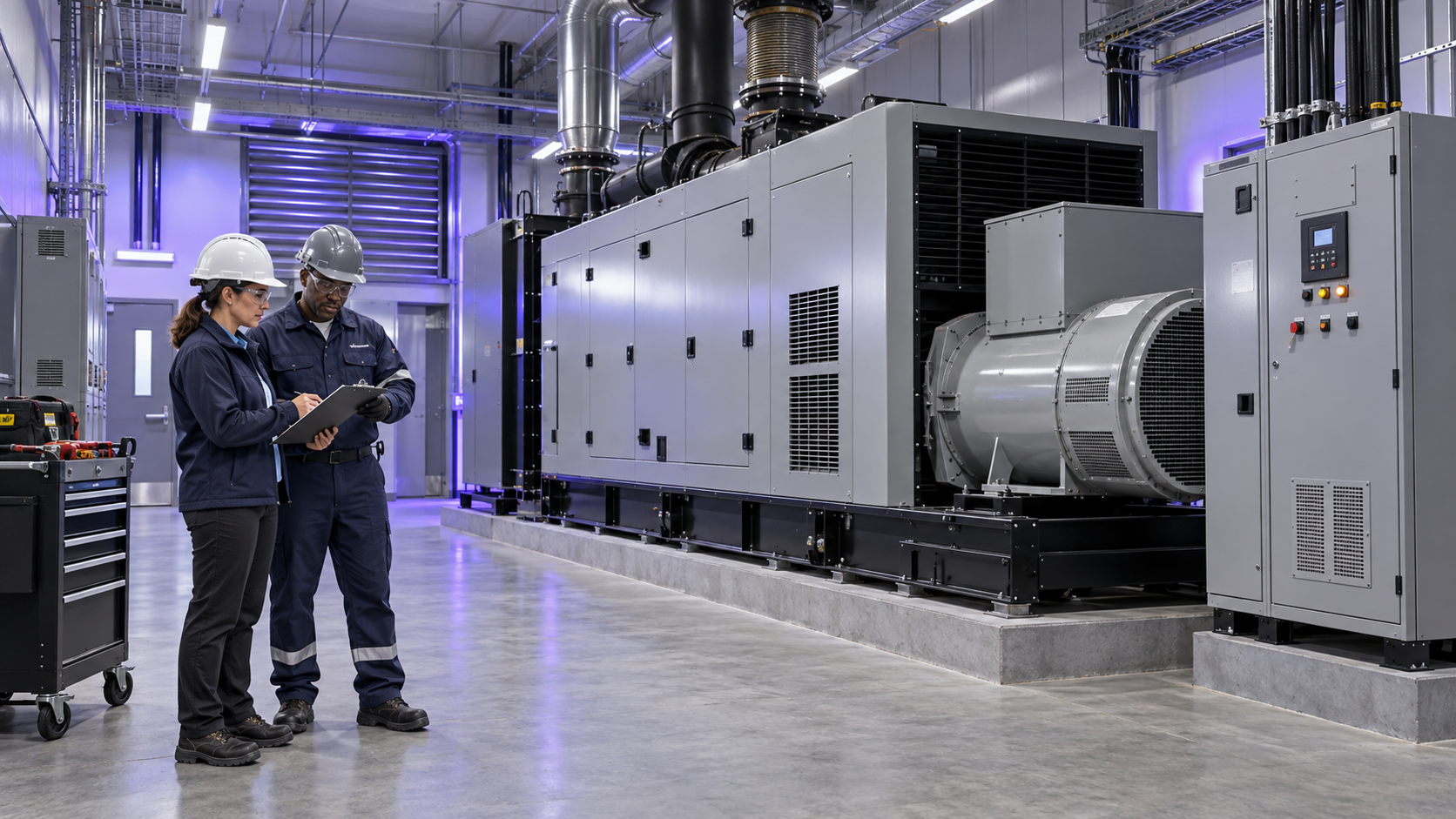
The Operational Question
When a standby generator is due for inspection, service, or load testing, is the site actually ready to take that equipment out of its normal operating posture? In a data center, generator maintenance is not just a mechanical appointment. It is a coordinated decision about electrical resiliency, fuel and exhaust systems, transfer equipment, permits, work controls, communications, and the facility's remaining margin during the work.
This checklist helps a data center facility manager, critical facilities engineer, or operations lead prepare for generator maintenance before a contractor opens a panel or changes a control setting. It explains what to verify, who should be involved, what evidence to capture, and how to turn a scheduled task into a controlled readiness event. The goal is not to replace the manufacturer's instructions, the site's electrical safety program, or qualified technical judgment. The goal is to make sure those controls are ready before the work starts.
Who This Affects
The issue appears in any site that depends on emergency or standby power, including:
- Enterprise data centers with a central generator plant serving multiple electrical rooms.
- Colocation facilities where a maintenance window can affect several tenants and contractual service commitments.
- Hyperscale or campus environments with multiple generator groups, paralleling switchgear, and staged capacity.
- Edge facilities where one generator, one automatic transfer switch, or one fuel delivery may carry most of the site's resilience.
- New facilities moving from construction turnover into operations, where drawings, alarms, and procedures may still be changing.
The people who need a shared picture include the facility manager, electrical lead, generator technician, controls or BMS operator, NOC representative, EHS manager, security desk, commissioning agent, and customer or tenant communications owner. A fuel supplier, electrical contractor, load-bank provider, or building owner may also be part of the work package.
The checklist matters most before a preventive-maintenance visit, annual service, battery replacement, governor or controller work, fuel-system repair, exhaust work, or a planned load-bank test. It also applies when a generator has recently failed a start test, shown unstable voltage or frequency, produced an unexpected alarm, or been modified as part of a capacity project.
What Can Go Wrong
Generator work can create risk even when the generator is not carrying a live facility load. Stored energy, automatic start functions, battery systems, rotating equipment, hot surfaces, exhaust gases, fuel, and connected electrical sources all remain relevant. A person who believes the unit is off may be exposed to an unexpected start, a remote start command, a backfeed path, or a still-energized control or auxiliary circuit.
The operational consequences can be just as serious. If a maintenance window is planned around one generator but the team has not confirmed the actual electrical lineup, an automatic transfer switch may respond differently than expected. A controller may be left in the wrong mode. A temporary load-bank connection may reduce access or create a trip hazard. A fuel issue may be discovered after the service window has closed, leaving the site with less runtime than the operating plan assumes.
There are also compliance and environmental considerations. OSHA electrical safe-work rules require an employer to establish appropriate practices for work near exposed energized parts, and lockout or tagout requirements apply when servicing equipment where unexpected energization or startup could injure someone. Fuel handling, exhaust discharge, noise, fire protection, and air-emissions obligations depend on the site, equipment, and jurisdiction. A training article can point managers toward those controls, but it cannot determine the site's legal duties or authorize work.
Common failure patterns include:
- Treating a vendor calendar invite as a complete method statement.
- Relying on a single-line diagram that does not reflect the current switchgear lineup.
- Forgetting that a generator can be commanded from a remote panel, BMS, or automatic sequence.
- Testing the engine without confirming the transfer path, load condition, and tenant impact.
- Recording a pass or fail without capturing the readings, alarm state, corrective action, and person responsible.
- Closing the work order while a temporary bypass, disabled alarm, or deferred repair remains in place.
The result may be an injury, an avoidable outage, a failed start during a utility event, a missed customer commitment, or a maintenance history that cannot support the next decision.
What Managers Should Check
Use the following sequence as a pre-task review. Adapt it to the equipment manufacturer's procedures, the site's electrical safety program, and the actual scope of work.
- Define the exact work and the success condition.
Write down whether the visit covers inspection, oil and filter service, coolant work, battery checks, controller updates, breaker testing, transfer testing, load-bank testing, fuel work, exhaust work, or troubleshooting. State what “complete” means. For example, completion might require a documented start, stable voltage and frequency, normal coolant and oil indications, restored automatic mode, cleared alarms, and an operations sign-off.
- Confirm the current electrical state.
Review the latest single-line diagram, generator lineup, automatic transfer switch status, paralleling controls, maintenance bypasses, and any temporary connections. Ask the electrical lead to verify what the drawings show against what is physically installed. Identify which sources remain available if one generator is unavailable and whether any load is already on a reduced-resilience arrangement.
Do not assume that a label such as “Generator 2” tells the whole story. Record the serving switchboard, transfer equipment, breaker status, control mode, and any interlocks that could affect the test. If the site has a distributed generation plant, identify the lead-lag sequence and whether the work could change the available starting or paralleling capacity.
- Verify isolation and unexpected-start controls.
The work package should identify every energy source and every remote or automatic start path. That may include the starting batteries, battery charger, generator output, utility or alternate source through transfer equipment, block heaters, control power, remote start circuits, and stored mechanical or hydraulic energy. Confirm the required lockout, tagout, try, and verification steps with the qualified person performing the work.
Clarify who is authorized to place the unit in test, manual, or off mode, who controls the key or access credential, and how the NOC will suppress or manage alarms. The control plan should state how the team will prevent a remote start during hands-on work and how normal automatic operation will be restored afterward.
- Check physical and environmental readiness.
Walk the room or yard before the contractor arrives. Look for clear egress, lighting, housekeeping, ventilation, drainage, spill response materials, fire protection access, and safe access to panels and batteries. Check for fuel or coolant leaks, unusual odors, damaged guards, loose covers, blocked air paths, and combustible storage near the generator.
For an indoor generator, confirm that exhaust discharge and combustion air paths are available for the planned test. For an outdoor unit, check weather exposure, fencing, security access, vehicle movement, and the condition of the enclosure. If a load bank, temporary cable, or fuel delivery is involved, include its footprint in the access and emergency plan.
- Confirm the test window and operating margin.
Choose a window that reflects the site's real load, not only the vendor's availability. Document the expected IT load, mechanical load, generator capacity, remaining redundant units, UPS autonomy assumptions, and any planned work on related systems. Identify the stop-work triggers, such as an unexpected alarm, unstable voltage, rising temperature, fuel leak, loss of the alternate source, or a change in tenant impact.
The manager should know what happens if the test cannot be completed. A useful contingency may be to leave the generator in a known safe state, restore automatic mode, notify the NOC, create a corrective work order, and schedule a second window. “We will see what happens” is not a contingency.
- Align people and communications.
Create one contact list for the work. Include the facility manager, qualified electrical person, generator technician, controls operator, NOC, security desk, EHS contact, customer communications owner, and emergency contacts. State who gives the start command, who watches the facility response, who can stop the work, and who confirms restoration.
Use a short pre-job brief that covers the scope, hazards, boundaries, radio channel, test sequence, stop-work criteria, and handback requirements. If the site has tenants or customers, communications should be based on actual risk and contract commitments. Avoid announcing a generic “generator test” without explaining what may change and when the site is back in its normal state.
- Capture useful evidence.
The record should be detailed enough for the next shift to understand the condition of the system. Capture:
- Date, equipment identifier, operating mode, and people performing and witnessing the work.
- Starting battery voltage or other manufacturer-specified observations.
- Start time, transfer response if tested, voltage, frequency, oil pressure, coolant temperature, and load readings where applicable.
- Alarm and event history before and after the test.
- Fuel level, leak observations, filter or fluid changes, and deferred items.
- Photos or readings required by the site's maintenance program, without exposing sensitive security information.
- Restoration checks, including automatic mode, remote monitoring, normal breaker state, and operator sign-off.
Use the asset-management system or work-order platform that the team actually uses. A perfect form that nobody completes is weaker than a concise record that is reviewed and acted on.
- Close the loop after handback.
The work is not complete when the engine stops. The team should verify the final lineup, control mode, alarms, remote visibility, covers, guards, housekeeping, and access controls. Review every exception with an owner and due date. If the generator failed a portion of the test, document the current operational limitation and update the risk or maintenance plan rather than hiding the result in a closed ticket.
Which Training Fits This Situation
For a technician who needs to understand the equipment and maintenance sequence, Generator Operations & Maintenance is the most direct match. It can support a role-based plan for technicians who inspect, operate, or coordinate service on standby generators. Generator Fundamentals is a useful starting point for a new technician or a facilities coordinator who needs the system vocabulary before participating in a work review.
If the manager's concern is the full emergency-power chain, Emergency/Standby Power Systems Fundamentals connects generator operation to the broader standby system. That is useful when the work also involves automatic transfer switches, emergency distribution, or facility-level operating decisions. When the work crosses into electrical safety, Data Center Electrical Safety Training, Electrical Safety & Best Practices, or OSHA Electrical Safety-Related Work Practices for Data Center Technicians can complement the site's qualified-person program. These are knowledge and best-practice courses, not substitutes for employer authorization, site procedures, or required hands-on qualification.
For an electrical team building a consistent path across UPS, batteries, generators, distribution, and safe work practices, the Power & Electrical Systems Bundle provides the most complete role-based grouping. A facilities manager may instead choose individual courses for different roles: generator operations for the mechanical or electrical technician, standby-power fundamentals for the coordinator, and electrical safety for people who work near electrical equipment. The right choice depends on the tasks each role is expected to perform and the gaps found in the site training matrix.
Learners receive a certificate of completion when they finish a course. The training supports a site's program; it does not grant a regulatory certification, license, CEUs, or PDHs, and no outside standards body certifies or endorses the course.
Common Mistakes to Avoid
- Scheduling a generator test without confirming which equipment is available to carry the facility if the test is stopped.
- Treating “off” on a local display as proof that all energy sources and remote start commands are controlled.
- Using a stale drawing or equipment label without a physical verification by the responsible electrical lead.
- Ignoring batteries, chargers, fuel systems, exhaust, hot surfaces, and ventilation because the assignment is called electrical testing.
- Letting several people issue commands without naming one test director and one stop-work authority.
- Failing to tell the NOC which alarms are expected and which alarms require escalation.
- Accepting a verbal “everything looked good” instead of recording readings, event history, exceptions, and restoration checks.
- Leaving a unit in manual, test, bypass, inhibited, or alarm-suppressed mode after the vendor departs.
- Buying a broad bundle for every employee without first mapping course content to actual role responsibilities.
Key Takeaway
Generator maintenance is a readiness decision as much as a maintenance task. A manager who confirms the electrical state, energy controls, operating margin, test roles, physical conditions, evidence requirements, and handback steps gives the technician a safer work package and gives the site a clearer answer about whether standby power is ready when needed. This week, walk one generator with the electrical lead and compare the current physical lineup, start controls, and restoration checklist against the procedure your team relies on.