The Operational Question
A planned clean-agent fire suppression test is not just a fire-protection vendor appointment. In a data center, it is an integrated facilities event that can involve releasing panels, detection zones, pre-discharge alarms, HVAC shutdowns, access controls, emergency communications, equipment interlocks, and the people working inside the protected space. The operational question is whether the team can test the system without exposing occupants, creating an avoidable discharge, or leaving the room in an unknown protection state afterward.
This guide gives facilities managers, operations supervisors, security leads, and commissioning teams a practical readiness framework. It explains what to confirm before a functional test, how to separate a control test from an agent release, which records matter, and how training should be assigned to the people who will inspect, authorize, witness, and restore the system. The goal is not to replace the system designer, authority having jurisdiction, manufacturer instructions, or qualified fire-protection technician. The goal is to help the data center owner make the work visible and controlled.
Who This Affects
This readiness problem appears in more places than a newly built hyperscale campus. It affects any site with a clean-agent or other gaseous suppression system protecting a room where people, electrical equipment, or business-critical operations may be present.
- Enterprise data centers may be testing a computer room, network room, UPS control room, or archive space while the business still depends on the equipment inside.
- Colocation facilities must coordinate the test with customers, remote hands, security, the network operations center, and the facility's own maintenance window.
- Hyperscale and campus environments may have many suppression zones with different release panels, agent types, room volumes, and cause-and-effect sequences.
- Edge sites often have smaller teams, less local fire-protection expertise, and more reliance on a traveling vendor or a central operations desk.
- Commissioning agents and project leads need to prove that detection, alarm, shutdown, release inhibit, and notification sequences match the approved design before turnover.
- Facility managers and critical facilities technicians may be asked to escort vendors, observe indicators, verify room conditions, or restore equipment after testing.
- Security and EHS leads may own evacuation coordination, visitor control, incident records, or audit evidence even when they do not operate the suppression panel.
The highest-risk situations are planned tests after a room remodel, a rack-row expansion, a change to HVAC controls, a generator or electrical upgrade, a panel replacement, or a long period without a full functional test. A protected volume can change when walls, doors, cable penetrations, partitions, ceiling systems, return-air paths, or equipment layouts change. A control sequence can also change when a BMS, fire alarm network, access-control system, or emergency power source is modified.
What Can Go Wrong
A clean-agent system is designed to act quickly, often by filling a protected volume with an extinguishing concentration after detection and a pre-discharge sequence. The same speed that protects equipment can create an occupant hazard if people are not warned and given time to leave. OSHA's fixed extinguishing system rules address warning, alarms, discharge hazards, and emergency action planning for systems that may expose employees to hazardous concentrations or combustion by-products. NFPA 2001 is the principal standard for clean-agent systems, but the applicable edition, local code, manufacturer instructions, and authority having jurisdiction still control the actual work.
The first failure mode is an unintended release. A technician can select the wrong test mode, leave an actuator connected, bypass the wrong circuit, or restore an output before the test team is ready. A panel can be left in an abnormal state while the room is occupied. A manual release station can be blocked, mislabeled, or misunderstood. A discharge can also occur when a detector is tested without the team agreeing whether the second detection input, cross-zone logic, abort switch, or time delay is active.
The second failure mode is an incomplete safety sequence. Occupants may hear a buzzer but not understand that they must leave immediately. A visual beacon may be hidden by a new partition. Doors may not close as expected. A horn may not be audible over cooling equipment. An abort or hold switch may be installed but not understood. HVAC shutdown may leave fans running, doors open, or dampers in a position that affects the protected volume. A test that proves one relay changes state but does not prove the complete cause-and-effect path can create false confidence.
The third failure mode is an unprotected room after the test. The releasing panel may show a supervisory or trouble condition. An agent cylinder may be isolated, a valve may not be fully restored, a detector may remain disabled, or a fan shutdown relay may be bypassed. A vendor may leave temporary test equipment installed. If a deficiency is not assigned and accepted, the site can operate for days believing the room is protected when it is not.
There are also operational and financial consequences:
- A false discharge can interrupt customer operations, damage equipment, create cleanup and recovery work, and trigger emergency response.
- An uncoordinated test can place contractors or employees in a room during a pre-discharge alarm or create confusion about whether the event is real.
- An incorrect HVAC or power interlock can affect adjacent rooms, cooling stability, or electrical availability.
- Missing records make it difficult to show what was tested, what was isolated, who authorized the work, and whether deficiencies were corrected.
- A changed room volume or unsealed penetration can undermine the designed concentration even if the panel and cylinders appear normal.
The point is not to treat every clean-agent test as an emergency. It is to treat the test as a controlled change to a life-safety and uptime system.
What Managers Should Check
Use the following framework before approving a functional test. The exact test method belongs to the qualified service provider and the approved procedure, but the owner should be able to answer each question.
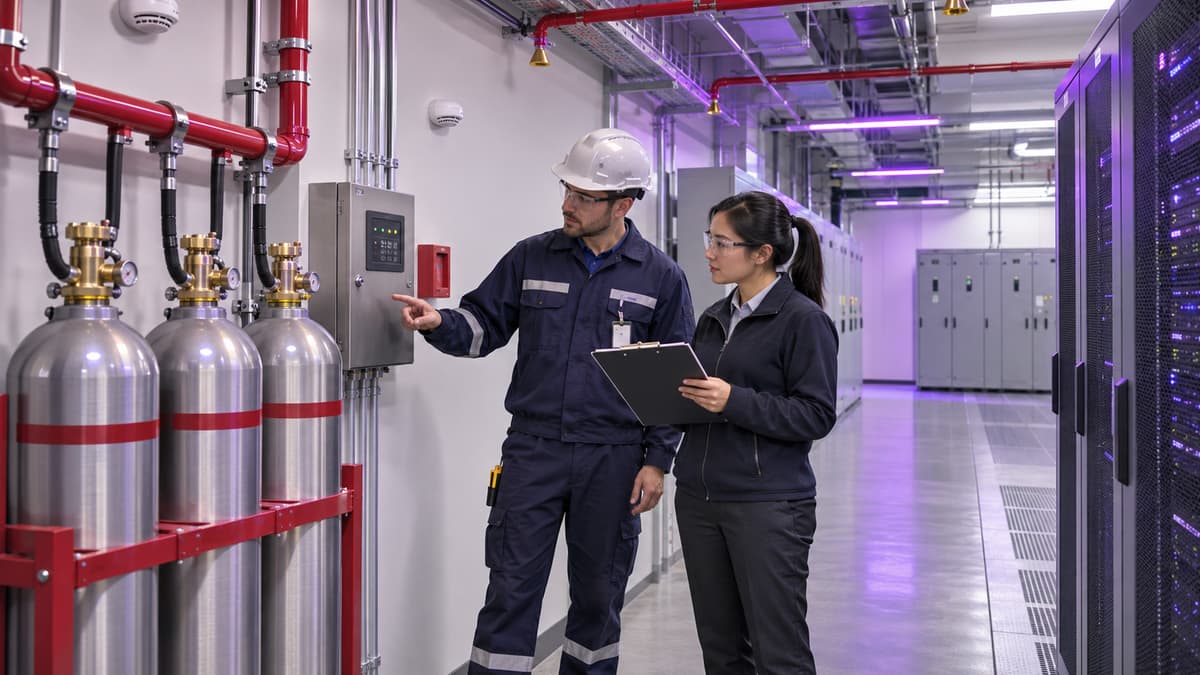
- Define the test boundary. Identify the protected room, adjacent spaces, agent type, cylinder bank, releasing panel, detection zones, manual controls, alarm interfaces, and equipment interlocks. Confirm whether the work is visual inspection, detector testing, alarm testing, integrated functional testing, enclosure testing, or an actual discharge. Put the boundary on the work order and test plan.
- Confirm the approved documents. Gather the latest as-built drawings, sequence of operations, cause-and-effect matrix, room volume calculation, equipment list, manufacturer instructions, previous test report, open deficiency log, and site emergency plan. If the room has changed since the last test, document the change rather than assuming the old record still describes the hazard.
- Name the decision makers. Assign an owner representative, qualified fire-protection technician, operations lead, safety or EHS contact, security contact, and communications or NOC contact. Clarify who can start the test, who can stop it, who can authorize a release inhibit, and who can declare the system restored. A vendor arrival time is not a responsibility matrix.
- Walk the protected space. Check that exit paths are clear, doors open and close correctly, warning signs are visible, manual release and abort controls are accessible, detectors and nozzles are not obstructed, cylinders are secured, pressure indicators are in the expected range, and the room layout matches the approved documentation. Look for new cable trays, partitions, racks, ceiling changes, unsealed penetrations, temporary storage, or construction dust.
- Coordinate occupancy and communications. Decide who must leave the room, when they must leave, how access will be controlled, and how a real alarm will be distinguished from a planned test. Notify the NOC, security desk, affected tenants, building management, monitoring provider, and emergency contacts as appropriate. Use a visible maintenance notice, but do not rely on a notice alone to protect a person who enters later.
- Control outputs and energy sources. Verify the approved method for disabling or isolating agent release, notifying the monitoring center, inhibiting equipment shutdowns, or placing systems in test. Use the procedure's safeguards and independent verification. Do not improvise by pulling wires, removing actuators, or defeating an interlock without documenting who performed the action and how it will be restored.
- Test the complete sequence. Where the approved procedure calls for it, verify the detector input, cross-zone logic, pre-discharge alarm, visual notification, time delay, abort or hold function, HVAC shutdown, door release or closure, access-control response, fire alarm annunciation, remote notification, and relevant equipment signals. A panel lamp test is not an integrated test. Record expected and observed results for each step.
- Maintain a live status board. During the work, show whether the zone is normal, in test, isolated, impaired, or restored. Record the start time, people in the room, vendor contact, active safeguards, and any temporary condition. This is especially useful at colocation sites where one team may start a test and another team may respond to an alarm later in the shift.
- Close the test deliberately. Reconnect or restore outputs using the approved sequence. Confirm the panel is normal, cylinders and valves are in service, detectors are enabled, notification and monitoring paths are active, doors and HVAC controls are returned to the intended state, and temporary signs or jumpers are removed. Have a second person verify the final condition when the procedure requires independent checking.
- Turn results into work. Obtain the signed test report, list every pass and deficiency, assign owners and due dates, identify compensatory measures for any impairment, and schedule retest or acceptance. Store the record with the room's maintenance history and the training or authorization records for the people who performed the work. A test is complete when the site understands its protection status, not when the vendor packs up.
For recurring readiness, managers can score each zone against four questions: Is the room still the same hazard that was designed? Can occupants recognize and exit the pre-discharge condition? Can the team prove each output and interlock? Can the site show that the system was restored and deficiencies were controlled? A weak answer in any one category should change the work plan.
Which Training Fits This Situation
The most direct course connection is Data Center Fire Suppression System Safety Training (Clean Agent Systems). It is a 2-hour knowledge course in the Security & Compliance track that can help facility staff understand system components, occupant warnings, protected-space hazards, and the boundaries of their role. It should support the site's procedures and qualified vendor work, not replace required technician qualifications, manufacturer training, code compliance, or the authority having jurisdiction.
A facility manager may pair that course with Security & Compliance for Data Centers when the site needs a broader view of physical controls, audit evidence, and compliance responsibilities. A security lead may add Data Center Physical Security and Access Control Training if the test requires controlled entry, badge restrictions, visitor escorting, or response coordination. An operations supervisor may add Incident Response & Troubleshooting to build a clearer handoff for alarms, impairments, and post-test abnormalities.
For a team, the Security & Compliance Bundle is a practical role-based option because it groups five courses covering security and compliance, access control, environmental compliance, fire suppression system safety, and physical security and access control. The right choice depends on the actual job assignments. The person who escorts a vendor does not necessarily need the same learning path as the person who operates a releasing panel or manages the impairment.
A simple role-based plan might look like this:
- Facility manager: fire suppression safety, compliance responsibilities, and document-control expectations.
- Critical facilities technician: fire suppression safety plus site procedure practice, panel familiarization, and supervised vendor walkthroughs.
- Security lead: fire suppression safety plus access-control and emergency communications coordination.
- NOC or operations lead: alarm recognition, escalation, customer notification, and restoration status.
- New technician: fundamentals first, then a supervised room walk and a documented demonstration of the site's test boundary.
Training produces a certificate of completion, but it does not grant a regulatory certification, license, or approval from OSHA, NFPA, or another standards body. Managers should use the course as one part of a controlled qualification and readiness program.
Common Mistakes to Avoid
- Treating a planned alarm test as permission to occupy the room during a pre-discharge sequence.
- Calling a panel lamp test a complete clean-agent system test.
- Assuming a new rack row, wall, cable tray, or ceiling penetration cannot affect the protected volume.
- Letting a vendor's test plan replace the owner's responsibility for occupancy, communications, monitoring, and restoration.
- Disabling an output without a named person responsible for the impairment and the return-to-service check.
- Leaving the monitoring provider or NOC out of the test window because the local panel is in test mode.
- Failing to record which detectors, inputs, relays, notification appliances, and interlocks were actually observed.
- Closing the work order when the panel is quiet even though a valve, detector, actuator, or remote signal remains abnormal.
- Giving every role the same training instead of matching learning to authority, exposure, and task.
- Using a course certificate as a substitute for manufacturer instructions, qualified service work, site authorization, or local code requirements.
Key Takeaway
Clean-agent suppression readiness is an owner-controlled coordination problem as much as it is a fire-protection service task. The team should know the test boundary, protect occupants, verify the complete cause-and-effect sequence, control impairments, and prove that the room is restored before normal work resumes. This week, choose one protected room and run a short readiness walk using the current drawing, room condition, responsible-person list, and restoration checklist. Record the first gap you find and assign it before the next test window.
Sources
- Occupational Safety and Health Administration, Fixed Extinguishing Systems
- National Fire Protection Association, NFPA 2001 Standard on Clean Agent Fire Extinguishing Systems
- U.S. Environmental Protection Agency, Substitutes in Fire Suppression and Explosion Protection
- U.S. Environmental Protection Agency, Frequent Questions on the Phasedown of Hydrofluorocarbons
- National Institute of Standards and Technology, Resilience for Critical Facilities