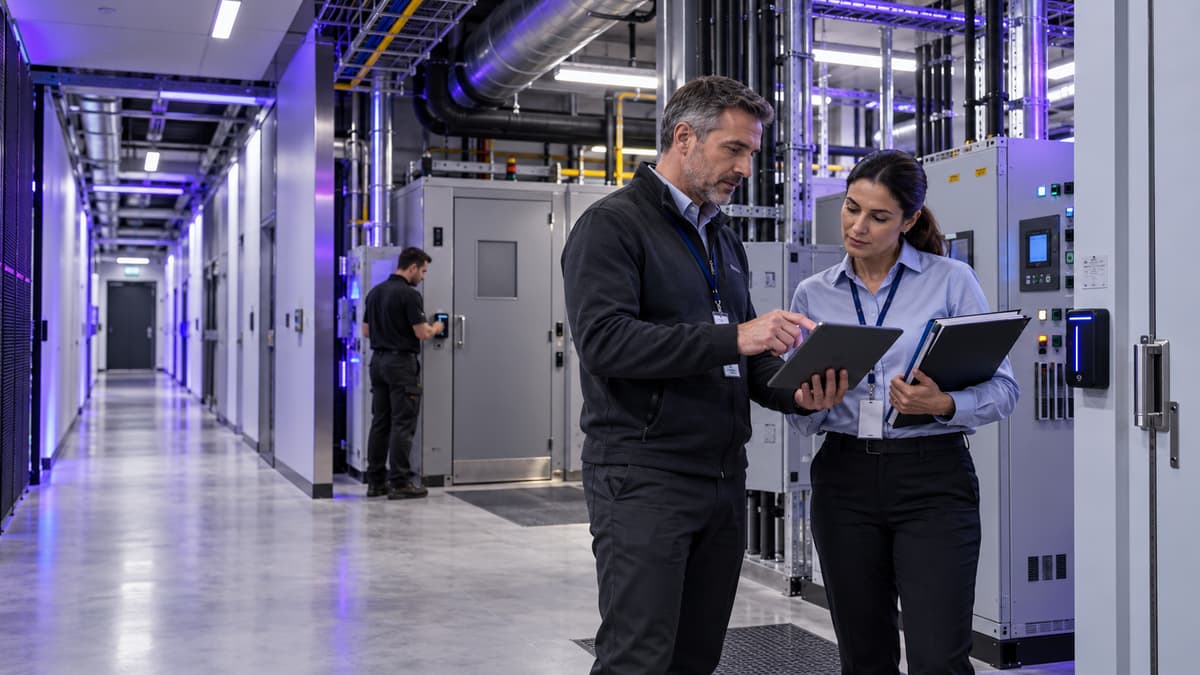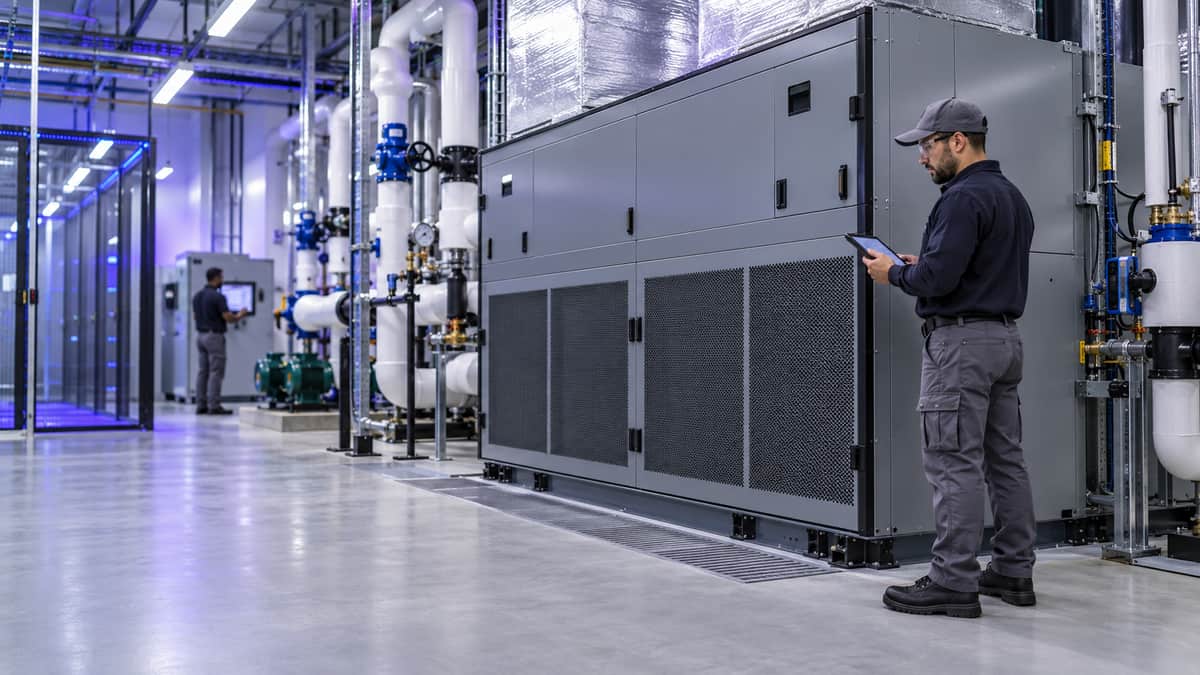
The Operational Question
Before a technician opens a panel, isolates a fan, changes a filter, or works on a CRAH unit, what should the team verify so the maintenance task does not create a cooling alarm, expose someone to an avoidable hazard, or leave the room without enough thermal margin? In a data center, a routine air-handler service call sits inside a larger chain that includes chilled-water or refrigerant systems, electrical distribution, controls, airflow paths, and the operations desk. A missed dependency can turn a short inspection into a hot-aisle alarm, an unexpected equipment trip, or a rushed restart.
This guide gives facility managers, mechanical technicians, and operations leads a practical pre-task framework for CRAH maintenance. It explains what to confirm about the work order, equipment state, access, isolation, controls, environmental conditions, and return-to-service checks. The goal is not to replace the site procedure, manufacturer instructions, qualified supervision, or required permits. It is to help a team recognize the information that should be in place before the first tool comes out.
Who This Affects
The immediate audience is the mechanical technician who works on computer-room air handlers, but the decision is shared by several roles:
- Facility managers deciding whether a unit can be removed from service during normal load, a maintenance window, or a seasonal transition.
- HVAC and mechanical technicians inspecting filters, coils, belts, bearings, dampers, valves, condensate systems, sensors, and fan assemblies.
- Critical facilities engineers coordinating chilled-water pumps, CRAH units, CRAC units, humidification, and room-level environmental targets.
- Operations managers and NOC staff watching alarms, trends, redundancy, and customer-impact indicators while work is in progress.
- Electrical technicians who may need to coordinate disconnects, motor starters, variable-frequency drives, control power, or panel access.
- Controls specialists responsible for BMS points, enable commands, alarms, sequences, and trend data.
- Contractors entering enterprise, colocation, hyperscale, or edge facilities under an escort, method statement, or change-control process.
- Training coordinators onboarding a technician who understands commercial HVAC but is still learning the consequences of work inside a live data center.
The same readiness question appears in different site types. An enterprise room may have fewer units but less staffing depth. A colocation site may have tenant commitments and stricter change windows. A hyperscale campus may use standardized equipment and detailed digital work packages, while an edge site may depend on one technician traveling between locations. In every case, the team must connect local equipment knowledge to the room's current operating condition.
What Can Go Wrong
The most common failure is not a dramatic mechanical break. It is a mismatch between the planned task and the live system. A work order might say “inspect CRAH-04,” while the actual job involves opening a fan compartment, disabling a control loop, entering a restricted area, or disturbing a valve that affects several units. If those boundaries are not clear, the technician and the operations desk may be working from different assumptions.
Cooling capacity can be lost in several ways. A unit may be disabled without confirming that the remaining units can carry the load. A replacement filter may be installed with poor fit, raising pressure drop and reducing airflow. A fan may restart unexpectedly because the BMS command, local selector, and safety interlock were not aligned. A control sensor may be left disconnected, causing a false reading or a sequence that drives other equipment in the wrong direction.
Water-related work adds another set of consequences. A loose connection, closed valve, blocked drain, or disturbed condensate trap can create a leak over an electrical room or under a raised floor. Even a small amount of water can trigger a leak-detection alarm, require an emergency response, and force a wider shutdown than the original maintenance task. Where a unit uses a refrigerant circuit, only the personnel, tools, recovery practices, and site controls appropriate to that work should be used. Do not treat refrigerant service as an informal extension of a visual inspection.
Electrical and mechanical hazards also overlap. A fan assembly can store kinetic energy after a stop command. A motor starter or VFD can retain hazardous energy after a disconnect is opened. Sharp coil fins, rotating components, unexpected actuator movement, and awkward access can produce injuries during a task that was described as “routine.” The site lockout and verification process must govern the job, including any electrical isolation, mechanical blocking, control-power isolation, or release of stored energy.
The business consequences are equally practical:
- A loss of cooling headroom can produce high-temperature alarms in a row, room, or containment zone.
- A failed restart can leave a unit unavailable during a period when another unit is already in alarm or maintenance.
- An undocumented control change can make the next shift troubleshoot a problem without knowing what was altered.
- Water or condensate damage can affect cabling, flooring, power equipment, or customer space.
- A poorly coordinated contractor task can create a permit, access, insurance, or evidence problem during a later review.
- Repeated reactive callouts can cost more than a planned inspection that identifies belt wear, clogged filters, sensor drift, or weak actuators early.
Standards and manufacturer requirements provide important context, but they do not make a course, employer, or individual automatically certified. Use the current site procedures, equipment documentation, qualified-person requirements, and applicable safety rules as the controlling authority.
What Managers Should Check
Use the following framework before approving work on a CRAH unit. The exact checklist should be adapted to the equipment and the facility's procedures.
- Define the task boundary.
The work order should state the unit identifier, location, reason for service, expected duration, equipment to be touched, and whether the job is inspection-only or includes adjustment, replacement, isolation, or functional testing. “Maintenance” is too broad by itself. Name the fan section, filters, coil, valve, damper, drain, sensor, actuator, VFD, humidifier, or control panel involved.
- Confirm the current operating picture.
Review supply-air and return-air temperatures, humidity, alarms, fan status, valve position, filter differential pressure if available, and recent trend data. Look at neighboring CRAH units and the room's thermal pattern, not just the target unit. A unit that appears healthy may be compensating for another unit, a blocked airflow path, a containment breach, or a recent load change.
- Establish cooling redundancy and limits.
Identify which units are available, which are already derated, and what operating condition would trigger a stop-work decision. Confirm the expected impact of taking one unit offline. For a colocation site, include customer or capacity commitments that limit acceptable temperature or humidity movement. The operations desk should know who can authorize a pause, restart, or escalation.
- Walk down access and work area conditions.
Verify lighting, housekeeping, floor condition, clearance around panels, access to disconnects, and the route for tools and replacement parts. Check for water, corrosion, unusual noise, vibration, hot surfaces, sharp edges, and signs of prior leakage. If the task involves a raised floor, overhead space, ladder, or restricted area, include those hazards in the pre-task discussion.
- Identify every energy source.
List normal power, control power, motor energy, rotating assemblies, pressure, water flow, steam or humidification energy where present, and any automatic start command. Coordinate with the person responsible for electrical isolation and use the site's lockout/tagout and verification process. A BMS “off” command is not a substitute for the required energy-control method.
- Check controls and monitoring dependencies.
Record the unit's normal mode, local selector position, enable command, alarm state, and any temporary overrides. Confirm how the BMS will display the unit during maintenance. If a sensor or actuator is disconnected, document it before the work begins. Decide who will watch the trend and which alarm indicates that the job must pause.
- Verify materials and recovery plan.
Have the correct filter dimensions, belts, fasteners, gaskets, drain materials, sensor type, and manufacturer-approved components available before isolation. For tasks involving water, plan containment and cleanup. For a refrigerant-related job, use the site's qualified-person and recovery requirements rather than improvising at the unit.
- Set hold points.
Agree on the points at which the technician stops and calls the operations desk: before opening a guarded section, before isolating the unit, after finding unexpected damage, before changing a control setting, before restoring power, and after the first functional test. Hold points make the decision visible to a new technician and reduce pressure to continue through an unexpected condition.
- Test the return-to-service sequence.
Before work starts, know how the unit should be restored. Confirm local controls, valve position, fan rotation or command response, alarm reset behavior, sensor readings, airflow indication, condensate condition, and BMS status. Allow enough time to observe the unit under stable operation instead of declaring success immediately after the fan starts.
- Close the documentation loop.
Record what was inspected, what changed, measurements taken, parts installed, alarms observed, isolation points used, and the final operating state. Attach photos or readings where the site procedure calls for them. A clear closeout gives the next shift a reliable baseline and helps the planner decide whether the task should recur sooner.
For onboarding, have a new technician talk through this sequence with an experienced lead before performing the task. The purpose is to demonstrate system awareness, not just tool use. The technician should be able to explain what the unit does, what can affect it, how the room responds if it is unavailable, and who must be notified before the state changes.
Which Training Fits This Situation
The best training path depends on the person's role and the depth of the work. A mechanical technician who needs stronger troubleshooting judgment may start with HVAC Systems Troubleshooting Essentials, including the course coverage of refrigeration-cycle concepts, CRAC/CRAH diagnostics, common failures, and maintenance best practices. That foundation supports better decisions when a unit has high pressure drop, abnormal vibration, unstable temperature, or a sensor reading that does not match the room.
For technicians and supervisors responsible for broader plant equipment, Mechanical Systems & Equipment Maintenance adds useful context around piping systems and water treatment, chiller operation and maintenance, vibration analysis, equipment health, lifecycle planning, and vendor coordination. CRAH readiness often depends on what happens upstream, so a team that understands pumps, valves, chilled-water quality, and equipment condition can investigate recurring symptoms more effectively.
Cooling Systems Design & Optimization is a fit for engineers and facility managers who need to connect unit-level work to airflow, containment, CRAC/CRAH system fundamentals, liquid-cooling interfaces, and free-cooling or hybrid-system decisions. It can help a manager ask a more useful question than “Can we take this unit offline?” The better question is “What does this unit contribute to the room's current airflow and heat-removal strategy, and what evidence supports the maintenance window?”
For planners and operations leads, Preventive Maintenance Planning supports the work-order side of the problem: equipment lifecycle fundamentals, maintenance scheduling, predictive maintenance basics, and documentation and tracking. It is especially relevant when the site is moving from reactive repairs to condition-based planning.
The Cooling & Facilities Efficiency Bundle can make sense when a team needs a shared baseline across technicians, supervisors, and managers. A role-based plan might look like this:
- A new mechanical technician completes HVAC Systems Troubleshooting Essentials, then shadows a CRAH inspection using the site's checklist.
- A senior technician adds Mechanical Systems & Equipment Maintenance and demonstrates a pump, valve, drain, and vibration walkdown.
- A facility manager or engineer adds Cooling Systems Design & Optimization to connect unit work with airflow, capacity, and efficiency decisions.
- A planner or operations manager adds Preventive Maintenance Planning and audits whether closeout data is becoming useful for future scheduling.
These are knowledge and best-practice courses. They provide a certificate of completion after finishing the course, but they do not grant a regulatory certification, license, CEUs, or PDHs, and they do not replace hands-on qualification, employer authorization, manufacturer requirements, or site-specific safety procedures.
Common Mistakes to Avoid
- Treating the BMS command as the complete isolation plan.
- Taking one CRAH offline without checking the status and available capacity of neighboring units.
- Starting work with a generic work order that does not identify the exact compartment or component.
- Ignoring recent trend data because the live temperature looks normal at the moment.
- Replacing a filter or belt without checking fit, alignment, airflow impact, and the manufacturer's requirements.
- Leaving a temporary override, forced point, disconnected sensor, or local selector change undocumented.
- Restoring power before confirming that guards, panels, drain paths, valves, and tools are in their normal condition.
- Declaring success as soon as the fan runs instead of observing alarms, temperatures, humidity, airflow, and control response.
- Assuming a contractor's commercial HVAC experience automatically includes live data center operating judgment.
- Closing the ticket with “OK” rather than recording measurements, parts, findings, and follow-up work.
One more mistake is training everyone identically. The person checking a filter, the person approving an outage window, and the person tuning a cooling sequence have different decisions to make. Shared vocabulary matters, but the training depth and practical demonstration should match the role.
Key Takeaway
CRAH maintenance readiness is a coordination skill as much as a mechanical skill. A safe, reliable task begins with a defined boundary, a current view of room conditions, confirmed cooling margin, controlled energy, known monitoring dependencies, and a deliberate return-to-service test. This week, choose one frequently serviced CRAH unit and walk its work order, isolation points, trend screen, and closeout record with a technician and an operations representative. Use the gaps you find to update one checklist and assign the next role-based training step.