
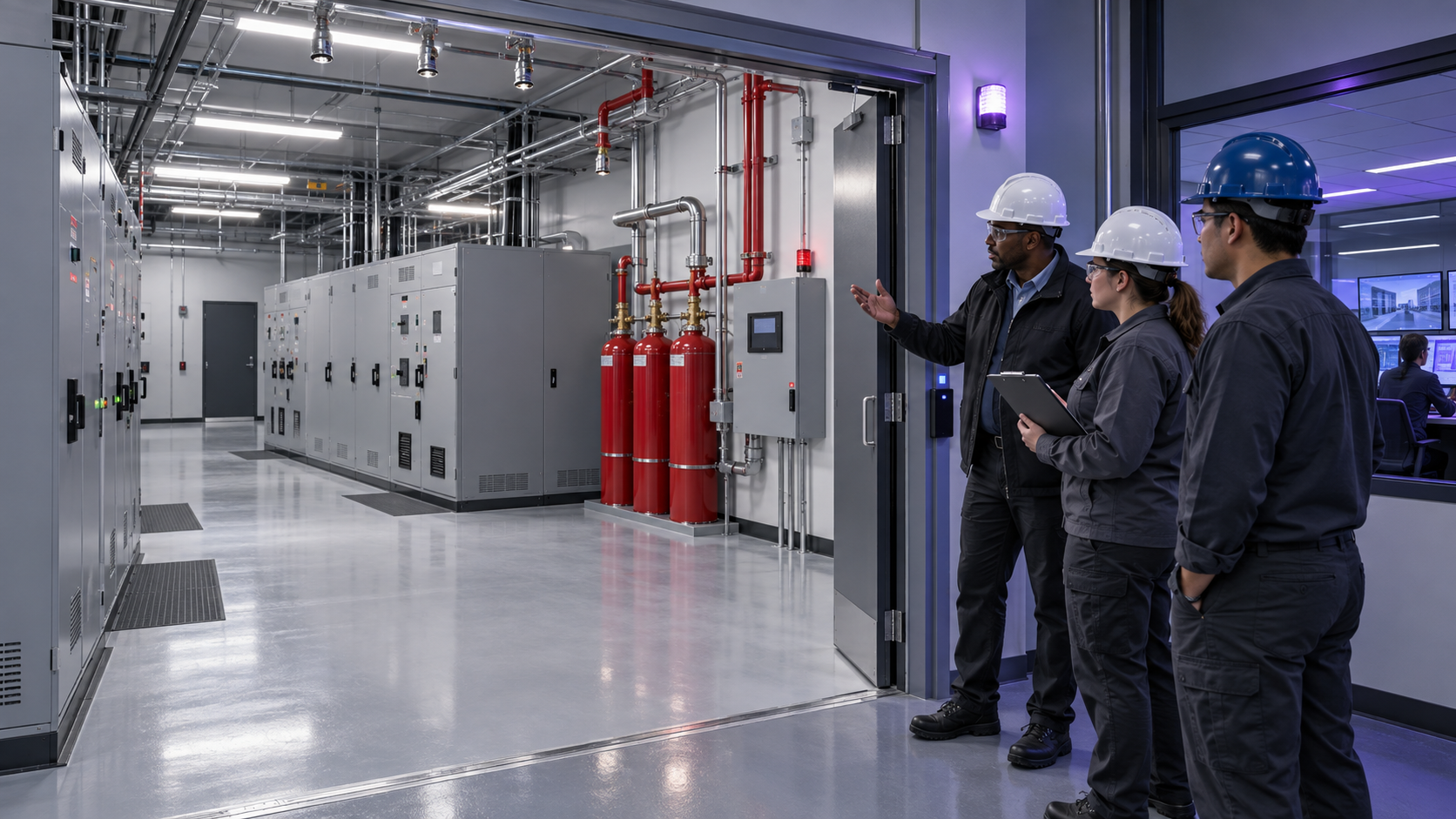
The Operational Question
When a clean-agent fire suppression system enters pre-alarm or release sequence, can the data center team recognize what is happening, protect people, coordinate with the fire protection system, and keep an unsafe response from creating a larger outage? In a critical facility, the answer cannot depend on one person remembering a panel display from a previous drill. The team needs a shared, practiced sequence that connects detection, investigation, evacuation, shutdown decisions, access control, communications, and post-event recovery.
This article explains how facility managers, control-room operators, security staff, electrical and mechanical technicians, and contractors can prepare for a clean-agent alarm without treating a training exercise as a substitute for the site’s approved fire protection design or emergency procedures. You will see what to verify before a drill, what information operators need during an alarm, how to divide responsibilities, and how to choose training that supports the plan. The goal is practical readiness: every person should know the next safe action, the limits of their authority, and where the official procedure takes over.
Who This Affects
This issue applies to more than the fire protection specialist. It affects anyone who may receive the first alarm, enter the protected area, direct a contractor, or make a decision about equipment status.
- Facility managers who own the emergency plan, impairment process, vendor coordination, and evidence that drills were completed.
- Control-room, NOC, and site operations staff who see the first alarm, acknowledge a panel, notify the response team, or monitor downstream equipment.
- Electrical technicians who may be working near UPS rooms, electrical rooms, battery areas, switchgear, or automatic shutdown interfaces.
- Mechanical technicians who work around air-handling equipment, dampers, pressure relief paths, and room conditions that can affect agent retention.
- Security and compliance leads who control doors, visitor accountability, access logs, cameras, and communication with responders.
- Commissioning agents and contractors who test detection, releasing circuits, abort stations, manual release stations, or cause-and-effect sequences.
The site type changes the scenario but not the need for clarity. An enterprise facility may have a small number of protected electrical rooms and a familiar local team. A colocation site may need to coordinate with multiple customer representatives, a security desk, and a remote operations center. A hyperscale campus may have several protected zones with different release logic. An edge site may have limited staffing and a technician responding alone after hours.
The risk is especially high during maintenance windows, construction, commissioning, hot work, battery replacement, generator testing, or a change in room use. A contractor who knows the equipment but not the site’s alarm sequence can be just as unprepared as a new operator who has never entered the protected zone.
What Can Go Wrong
A clean-agent system is designed to control a fire while limiting damage to sensitive equipment, but it still creates a serious life-safety and operational event. The consequences depend on the agent, the room, the detection sequence, the release logic, ventilation controls, and the actions people take. A manager should avoid assuming that a clean-agent alarm is merely a nuisance alarm or that stopping the release is always the safest choice.
The first failure is often an unclear distinction between stages. A detector may create a supervisory or pre-alarm condition. A second detection input may start a countdown or release sequence. A manual release station may bypass some delay. An abort station may have a limited function defined by the system design. If operators treat every audible signal as the same event, they can delay evacuation, reset equipment too early, or communicate the wrong status to responders.
The second failure is people entering the protected room after release. A clean-agent concentration may reduce oxygen or create other hazards depending on the agent and concentration. A room can also contain smoke, energized equipment, hot surfaces, battery hazards, or a separate fire that has not been controlled. No operator should rely on a visual check through a window or on the absence of visible smoke as permission to enter. Re-entry criteria must come from the site emergency procedure and qualified responders.
The third failure is a loss of coordination with building systems. Dampers, door closers, air handlers, exhaust fans, power shutdowns, and alarm interfaces may be part of the engineered cause-and-effect sequence. If a technician manually changes one of these systems without understanding the sequence, the room may not hold the intended concentration, a neighboring space may be affected, or equipment may shut down in an unexpected order.
The operational consequences can include:
- Injury or exposure because personnel did not evacuate, could not hear the alarm, or re-entered without authorization.
- An avoidable equipment outage when a manual response interrupts UPS, cooling, monitoring, or distribution equipment.
- Loss of evidence when a panel is reset before the event history, detector status, and communications are recorded.
- A prolonged impairment when a discharge, failed test, damaged detector, or disabled releasing circuit is not documented and escalated.
- Confusion for customers, emergency responders, or a remote operations center because the site cannot state whether the system is in alarm, released, isolated, or restored.
The standards context matters, but it must be used carefully. OSHA requirements for emergency action planning address procedures for reporting emergencies, evacuation, accountability, and rescue or medical duties where applicable. The fire suppression system itself must be installed, inspected, tested, and maintained according to the applicable design, manufacturer instructions, and adopted codes and standards. A course or drill can help a team understand its role, but it does not certify a person to design, service, or approve a suppression system.
What Managers Should Check
Use the following framework to evaluate readiness before scheduling a drill or accepting a new protected room. The exact steps must match the approved site procedure and the installed system.
- Map the alarm path. Identify each protected zone, detection stage, releasing panel, remote annunciator, manual release station, abort station, audible and visual notification device, and monitoring destination. Verify that the map uses the same zone names people see on the panel and in the control room.
- Define the first five minutes. Write down who receives the first notification, who calls the site lead, who initiates evacuation or accountability, who meets responders, and who protects the control room from conflicting instructions. Do not leave the first call to an informal group chat.
- Separate acknowledgment from investigation. A person may acknowledge an alarm at a panel to silence a local sounder if the procedure allows it. That action does not mean the event is understood, the hazard is gone, or the system can be reset. Train operators to record the panel state before taking a permitted action.
- Verify room-specific conditions. Check occupancy limits, door signage, egress routes, access control behavior, emergency lighting, communication coverage, and any battery, electrical, or mechanical hazards. A room that is normally unoccupied may still contain a contractor or a technician during a maintenance window.
- Review interfaces. Confirm what the release sequence is expected to do to air handlers, dampers, fans, doors, equipment shutdowns, and remote alarms. Use the approved cause-and-effect matrix, not memory. Any discrepancy should be treated as a commissioning or maintenance issue.
- Control impairments. If a releasing circuit, detector, notification appliance, or suppression cylinder is isolated, document the reason, affected zone, start time, compensating measures, owner, and restoration deadline. Make sure security, operations, EHS, and the fire protection vendor know about the impairment.
- Plan contractor participation. Before work begins, tell contractors which signals they may see, where they must report, who can authorize a test, how to stop work, and how to exit. Include a pre-task brief for testing that could create a release signal. Confirm that everyone understands whether the drill is live, test-mode, or discussion-only.
- Test accountability. A roster is not enough if it cannot be used quickly. Decide how the site accounts for employees, visitors, cleaners, delivery personnel, and contractors. Test the handoff between the security desk, the incident lead, and the person responsible for customer or employee information.
- Preserve event information. Define who captures panel displays, timestamps, alarm history, detector identifiers, work permits, access records, radio traffic, and operator actions. The record should explain what the team knew at each point, not only the final outcome.
- Set restoration criteria. Identify who may reset the panel, who confirms the room is safe, who verifies the system is returned to normal, and who closes the impairment. A clean screen is not proof that the system has been inspected or that every interface has been restored.
For a useful exercise, run three versions of the scenario: a staffed daytime event, an after-hours event with one technician on site, and an event during a planned maintenance window. Change one detail in each scenario, such as a contractor in the room, a remote annunciator that does not report, or a door that does not close. The objective is to expose handoff gaps without creating an unsafe live release.
Which Training Fits This Situation
The most direct course match is Data Center Fire Suppression System Safety Training (Clean Agent Systems). It is useful for the people who need to understand protected zones, alarm stages, safe response boundaries, system interfaces, and the difference between awareness and service authority. The course should be assigned according to role. An operator may need alarm recognition and escalation. A facility manager may need impairment control and drill governance. A technician may need a stronger understanding of room conditions and equipment interfaces.
For a broader program, the Security & Compliance Bundle includes Security & Compliance for Data Centers, Access Control & Physical Security, Facility Environmental Compliance, Data Center Fire Suppression System Safety Training (Clean Agent Systems), and Data Center Physical Security and Access Control Training. That combination fits a team that must connect fire response with access control, documentation, audits, and physical facility responsibilities.
Operations personnel may also benefit from Incident Response & Troubleshooting or Data Center Operations Management. These courses can support the handoffs around event logging, escalation, recovery, and coordination with a remote operations center. They do not replace the site’s fire protection vendor, licensed or qualified service personnel, emergency responders, or the approved emergency action plan.
A practical role-based plan can look like this:
- Assign the fire suppression safety course to all personnel who may work in or respond to protected rooms.
- Add security and physical access training for the security desk, escorts, and compliance leads.
- Add incident response training for shift leads and control-room operators who coordinate the first response.
- Brief contractors on the local sequence before each test or maintenance task, even if they have completed general training elsewhere.
- Use a short site drill or tabletop exercise to verify that training transfers into the actual panel names, radio channels, access controls, and accountability process.
The provider describes these as self-paced knowledge and best-practice courses. A learner receives a certificate of completion after finishing, but the course is not a regulatory license, certification exam, CEU, or approval by OSHA, NFPA, or another standards body. Managers should use the training to support a documented site program and then verify competence through supervised procedures, drills, and qualified system work.
Common Mistakes to Avoid
- Treating a pre-alarm as harmless because the agent has not discharged yet.
- Giving every operator permission to bypass, isolate, reset, or release equipment without role-specific authorization.
- Testing detectors or releasing circuits without notifying the control room, security desk, affected contractors, and monitoring contacts.
- Assuming the fire alarm panel, BMS, DCIM, and access-control system show identical information. Confirm which system is authoritative for each decision.
- Failing to include after-hours staffing, customer representatives, visitors, or lone workers in the scenario.
- Using a generic evacuation map that does not show the actual protected zone, alternate exit, muster location, or access restrictions.
- Restoring a system based only on a vendor phone call or a panel that appears normal. Require the site’s defined inspection and closeout evidence.
- Confusing completion of an online course with authorization to service suppression equipment or make engineering changes.
- Letting a drill become a performance exercise where everyone knows the script. Vary the location, staffing, and communication path so the team practices judgment.
Key Takeaway
Clean-agent readiness is a coordination skill as much as a fire protection topic. The best-prepared data center teams know what each alarm stage means, evacuate without debate, preserve the event record, protect access, communicate one status, and restore the system only through the approved process. This week, choose one protected room and walk the first five minutes with the shift lead, security desk, and the person responsible for the fire protection system. Record one ambiguity, assign an owner, and update the procedure before the next alarm or maintenance window.