The Operational Question
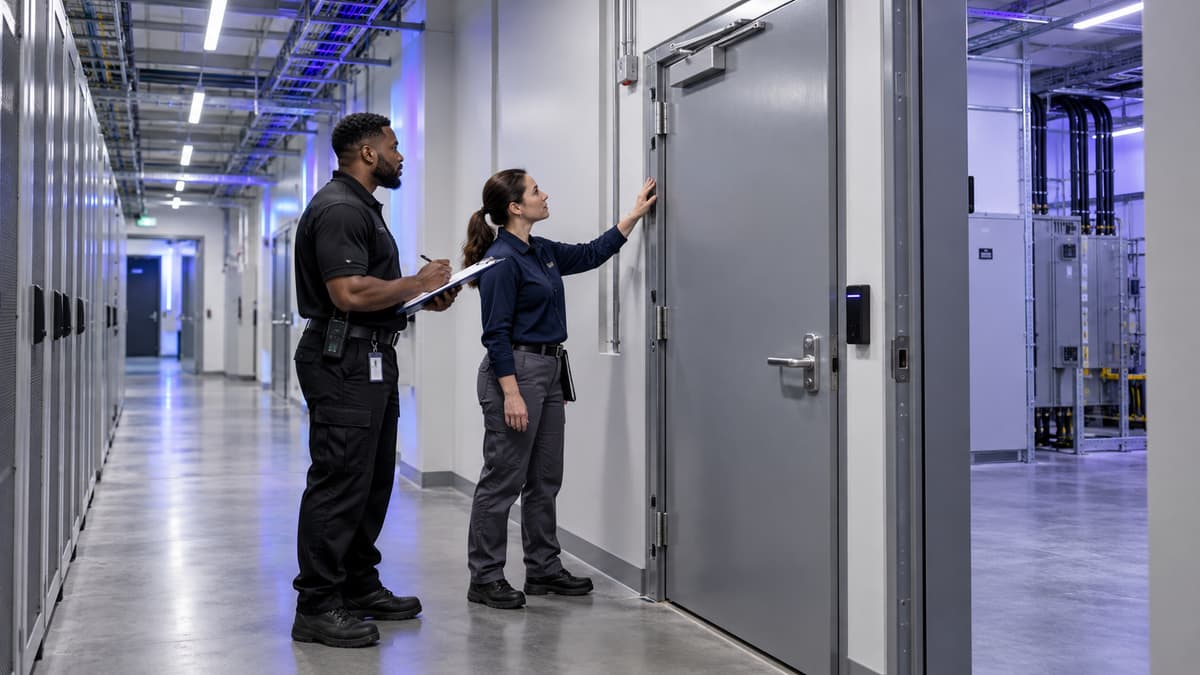
During a critical-facilities walkthrough, a fire door can look like a simple building component until a technician finds it propped open, blocked by a cart, missing its closer, or unable to latch. The operational question is not only whether a door appears intact. It is whether the facility can demonstrate that fire-rated openings, access controls, alarm interfaces, and evacuation routes are being kept ready for the conditions the site has planned for.
This matters because a data center has competing priorities. Operations staff want fast movement between electrical rooms, battery rooms, generator spaces, loading areas, and white space. Security teams want controlled access. Facilities teams need doors to support fire separation and safe egress. A door that is convenient for one group can create an unreviewed weakness for another. This guide gives facility managers a practical way to walk the site, identify evidence gaps, coordinate repairs, and turn observations into role-based training actions without treating a course as a substitute for the site’s fire-protection engineer, authority having jurisdiction, or approved procedures.
By the end, the reader should be able to organize a fire-door walkthrough around four questions: does the opening perform its intended function, can people use it safely, do alarms and access controls behave as expected, and can the team prove who checked it and what happened next?
Who This Affects
This issue affects more than the person responsible for building maintenance. It is common in enterprise campuses, colocation facilities, hyperscale sites, edge rooms, and leased data halls where several employers share the building or where the landlord controls portions of the fire-life-safety system.
The people most likely to encounter it include:
- Facility managers who own the condition of rooms, doors, barriers, work orders, and vendor coordination.
- Critical facilities technicians who move through electrical rooms, UPS areas, battery rooms, generator spaces, mechanical rooms, and loading zones during routine work.
- Security leads who administer badge permissions, door alarms, mantrap settings, visitor access, and access-log reviews.
- EHS managers who connect evacuation planning, emergency action plans, contractor controls, and inspection evidence.
- Commissioning agents and project managers who need to confirm that new doors, hardware, alarms, and access-control points are handed over with useful records.
- NOC and site operations staff who receive door-held-open, forced-door, fire-alarm, or supervisory signals and must know who responds.
- Maintenance contractors who service closers, hinges, panic hardware, locks, card readers, smoke seals, and associated devices.
The situation can become especially difficult during a hot work project, a battery replacement, a generator service window, a customer move-in, a construction phase, or a temporary impairment of the fire alarm or suppression system. A door may be physically sound but temporarily unavailable, electronically normal but mechanically unable to close, or secure against unauthorized entry while creating an unsafe evacuation condition. The walkthrough must capture those differences.
What Can Go Wrong
The most visible failure is a door that does not close and latch. That can allow smoke or heat to move through an opening that was intended to limit fire spread. The less visible failure is an unclear response: a door alarm appears on a security console, but no one knows whether facilities, security, the fire alarm vendor, or the shift lead owns the next action.
Several consequence paths can overlap:
- A blocked or locked exit can slow evacuation or force people toward a less familiar route.
- A missing closer, damaged frame, or failed latch can reduce the effectiveness of a fire-resistance assembly.
- A door held open for cable movement can remain that way after the work ends because no one owns the closeout check.
- A badge reader can deny authorized entry during an emergency, or an access-control release can behave differently from the documented life-safety sequence.
- A door contact can report normal while the leaf is not fully seated, depending on how the sensor is mounted and configured.
- A temporary construction partition can change the intended travel path without updating signs, maps, escorts, or the emergency action plan.
- An impairment can be recorded in a ticketing system but not communicated to the people who operate the affected room or alarm panel.
OSHA’s emergency action plan rule identifies procedures for reporting a fire, evacuation routes, employees who remain to operate critical plant operations, accountability after evacuation, rescue or medical duties, and responsible contacts. That means a data center cannot treat the door inspection as an isolated facilities checklist. The door condition has to connect to the site’s emergency roles and communication plan.
OSHA also says that fire detection system servicing, maintenance, and testing must be performed by a trained person knowledgeable in the system’s operations and functions, and that systems should be restored to normal operating condition promptly after testing or an alarm. For a data center, that creates a practical handoff requirement: if a door inspection touches fire alarm interfaces, release hardware, smoke control, or supervisory signals, the team needs a defined test and restoration record rather than an informal verbal confirmation.
An audit can expose these problems even when there has been no incident. A manager may have a work order that says “door repaired” but no evidence of the observed defect, the replacement part, the post-repair test, the alarm reset, or the person who accepted the result. A clean-looking door is not the same as a controlled process.
What Managers Should Check
Use a repeatable route and a consistent record. The goal is not for a manager to make a code judgment outside their authority. The goal is to identify conditions that require qualified evaluation, confirm that the site’s approved design and procedures are still represented, and ensure every exception has an owner.
1. Define the route and the reference set
Before walking, gather the current room list, floor plans, egress maps, door schedule, access-control point list, fire alarm device list, impairment log, open work orders, and most recent inspection or service reports. Mark which doors separate electrical, battery, mechanical, generator, storage, office, loading, and customer areas.
Confirm whether the walkthrough includes:
- Fire-rated doors and frames in rated walls.
- Exit doors, panic hardware, and doors on designated evacuation routes.
- Doors with badge readers, request-to-exit devices, door-position switches, or forced-door alarms.
- Doors connected to fire alarm release, smoke control, or emergency unlocking sequences.
- Temporary doors, construction barriers, or doors affected by a current project.
If the list is incomplete, record that as a data-quality issue. A site cannot manage door readiness if it does not know which openings are in scope.
2. Check the physical condition without overstepping the inspection authority
Look for observable conditions that merit correction or specialist review:
- The leaf is twisted, damaged, or rubbing the frame.
- Hinges, fasteners, closer arms, coordinators, or latching hardware are loose or damaged.
- The door closes slowly, slams, stops short, or fails to latch from a normal opening position.
- The frame has gaps, impact damage, unsealed penetrations, or evidence of unauthorized modification.
- A wedge, chair, magnet, cable, pallet, cart, or temporary tie keeps the door from closing.
- A threshold, floor transition, or weather seal creates a trip hazard or prevents full closure.
- Vision panels, labels, signs, or hardware have been replaced with parts that do not match the approved assembly.
Do not solve every problem by adjusting hardware on the spot. Some doors require listed components, manufacturer instructions, fire-door inspection expertise, or approval from the building owner and authority having jurisdiction. The manager’s job during the walkthrough is to identify, protect, escalate, and document.
3. Test the user experience and the emergency sequence separately
A door can behave correctly for a badge-holder and incorrectly for someone evacuating. Ask the team to demonstrate normal entry, normal exit, denied entry, door-held-open indication, forced-door indication, and any approved emergency release sequence using the site’s procedure and test authorization.
Verify who observes each side of the interface. One person at the door may miss what appears on the security console, fire alarm panel, BMS, or incident channel. A useful test record identifies:
- The door or opening reference.
- The normal operating state before the test.
- The action performed and the approved test window.
- The local indication and the remote indication.
- The response time or escalation expectation defined by the site.
- The reset or restoration action.
- The person who accepted the result and any follow-up ticket.
Do not assume that “alarm received” means the system is ready. Confirm that the signal was understandable, routed to the correct group, associated with the correct door, and cleared without leaving an impairment or bypass in place.
4. Review temporary conditions and contractor controls
The worst door condition often occurs during work that is otherwise legitimate. A contractor may need to move a panel, stage a tool cart, route a temporary cable, or hold a door while bringing equipment into a room. The manager should verify that the work plan states when the opening may be held, what compensating measures apply, who watches the door, and how closeout will be confirmed.
For a project or maintenance window, check:
- The affected doors are named in the work package, not described only as “access points.”
- The impairment or temporary condition is entered in the site’s approved log.
- Security and operations know the expected alarm behavior.
- Fire protection, building management, or the landlord has been notified when required.
- Egress remains available and signs or route maps still match the conditions.
- A responsible person performs the end-of-shift and end-of-work inspection.
- Any temporary release, bypass, prop, or alarm suppression is removed and tested.
This is where the walkthrough becomes a management control. The team is not only checking a door. It is checking whether work authorization, communication, and restoration are connected.
5. Organize evidence so another person can reconstruct the decision
Take location-specific notes that distinguish an observation from a conclusion. “Door 2-14 is held open by a wedge during filter delivery” is more useful than “fire door issue.” Add a photo if site policy permits, the work-order number, the equipment or door identifier, the risk owner, and the due date.
Keep the evidence set proportional to the site’s process, but make sure it can answer:
- What was inspected?
- When was it inspected?
- Who performed the check?
- What condition was found?
- What immediate protection was applied?
- Who was notified?
- What repair or evaluation was required?
- How was normal operation verified?
NIST SP 800-53 includes a Physical and Environmental Protection control family and emphasizes documented policies, procedures, roles, and review. A data center may not use NIST as its only control framework, but the principle is useful: physical protection should be managed as a repeatable, assigned, reviewable activity rather than as informal knowledge held by one experienced technician.
Which Training Fits This Situation
The best training assignment depends on the role and the work the person is expected to perform. The purpose is to build shared understanding of the facility’s hazards, interfaces, and escalation path. These are knowledge and best-practice courses with certificates of completion. They are not regulatory certifications, licenses, or endorsements by OSHA, NFPA, NIST, or another standards body.
For a facility manager or security lead building the overall program, Security & Compliance for Data Centers is a useful foundation for connecting physical controls, access expectations, evidence, and audit conversations. The Security & Compliance Bundle can support a broader role-based plan when the team also needs environmental, incident, and facility-control coverage.
For technicians and supervisors who maintain doors, fire protection interfaces, and building systems, Data Center Fire Suppression System Safety Training (Clean Agent Systems) can help establish the operational context for alarms, release concerns, evacuation, and restoration. It should be paired with site-specific procedures and qualified system-service requirements.
For managers who coordinate work in rooms with electrical, mechanical, and building hazards, Facility Environmental Compliance and Building Maintenance Fundamentals can help organize inspection routines, contractor expectations, documentation, and escalation. For incident ownership, Incident Response & Troubleshooting or Data Center Operations Management can help connect a door alarm or fire-protection impairment to shift handoffs, communications, and closeout.
A practical role-based plan could assign:
- Facility managers: Security & Compliance for Data Centers plus Facility Environmental Compliance.
- Security operators: Security & Compliance for Data Centers plus the site’s access-control and emergency procedures.
- Critical facilities technicians: Building Maintenance Fundamentals plus Data Center Fire Suppression System Safety Training (Clean Agent Systems).
- Shift leads and NOC staff: Data Center Operations Management plus Incident Response & Troubleshooting.
- New contractors: a short site orientation, door and egress rules, reporting expectations, and only the course content relevant to their assigned work.
Training does not prove that a particular door assembly is compliant. It helps the people who operate around that assembly recognize conditions, follow the approved process, and communicate clearly when a specialist decision is required.
Common Mistakes to Avoid
- Treating every door as a security problem and ignoring its egress or fire-separation function.
- Treating every door as a facilities problem and failing to include security, EHS, operations, or the landlord.
- Assuming a door contact proves that the door is fully latched and physically capable of performing its intended function.
- Leaving a wedge, magnet, bypass, or temporary hold-open device in place after a delivery or maintenance task.
- Testing a fire alarm or release interface without a written scope, notification plan, restoration check, and named observer.
- Closing a ticket with “repaired” when the record does not say what was repaired or how normal operation was verified.
- Replacing hardware with a convenient part without confirming that it is appropriate for the assembly and approved by the responsible authority.
- Using a generic floor plan after a construction change has altered doors, routes, rooms, or access points.
- Giving contractors a general safety briefing but not explaining who owns the door during their work and at closeout.
- Treating a course certificate as permission to inspect, repair, reset, or approve a life-safety system outside the person’s role.
The recurring theme is ownership. If a door can be held open, bypassed, alarmed, released, repaired, or reconfigured, the process needs to say who can authorize that action and who verifies that normal conditions returned.
Key Takeaway
A fire-door walkthrough is most useful when it connects physical condition, safe movement, access control, fire-alarm behavior, temporary work, and evidence. Facility managers should make the route specific, involve the people who see different parts of the system, and escalate technical judgments to the qualified parties responsible for the building and fire-protection design.
This week, walk one electrical-room-to-egress route with a facilities technician and a security operator, test one approved door-alarm scenario, and record the result from observation through restoration.
Sources
- Occupational Safety and Health Administration, 29 CFR 1910.38 Emergency action plans
- Occupational Safety and Health Administration, 29 CFR 1910.164 Fire detection systems
- Occupational Safety and Health Administration, Emergency Preparedness and Response: Getting Started
- National Institute of Standards and Technology, SP 800-53 Rev. 5 Security and Privacy Controls